AdsMG.ai vs HubSpot — at a glance:
| AdsMG.ai | HubSpot | |
|---|---|---|
| Primary use | AI ad copy & campaign optimization | CRM, email & inbound marketing |
| Best for | Paid advertising teams | Inbound/content marketing teams |
| Free tier | Yes — full tool access | Yes — limited CRM features |
| Starting price | $0 | $15/mo (Starter) |
| Ad platform support | Google, Meta, LinkedIn, TikTok | Limited (via integrations) |
| AI features | Ad copy generation, optimization | Content suggestions, email AI |
| Verdict | Best for paid media ROI | Best for full marketing suite |
Two of the most-discussed marketing platforms right now are AdsMG.ai and HubSpot — but they’re solving fundamentally different problems.
HubSpot is a CRM and inbound marketing platform. AdsMG.ai is an AI-native advertising and performance marketing platform. Understanding which one is right for your business starts with understanding that distinction.
This comparison breaks down both platforms across every major category: features, pricing, ease of use, and ideal use cases.
At a Glance
| AdsMG.ai | HubSpot | |
|---|---|---|
| Primary focus | AI advertising & ad performance | CRM & inbound marketing |
| Best for | Paid media teams, performance marketers | Sales, inbound marketing, customer lifecycle |
| AI depth | Native AI across all advertising functions | AI features added across the platform |
| Ad management | Core feature | Limited (mostly through integrations) |
| CRM | Not included | Core feature |
| Ease of use | Simple, advertising-focused UI | Moderate — broader feature set adds complexity |
| Free plan | Free trial | Free tier available (limited) |
| Pricing | Competitive, no % of ad spend | Scales significantly with contacts and features |
Feature Comparison: Advertising and Paid Media
This is where the two platforms diverge most significantly.
AdsMG.ai is built from the ground up for paid advertising:
- Multi-platform ad management: Run and optimize campaigns across Google, Facebook, Instagram, LinkedIn, and more from a single dashboard
- AI ad copy generation: Generate and A/B test dozens of copy variations in live campaigns
- Autonomous bidding optimization: AI manages bids across every auction in real time
- Audience targeting AI: Identifies and expands to your highest-converting audience segments automatically
- Creative rotation and optimization: Automatically shifts budget to best-performing creative variants
- Cross-channel attribution: Unified view of performance across all paid channels
HubSpot offers limited native advertising tools:
- Ad management is available but secondary to the platform’s core CRM/inbound use case
- Primarily tracks ad performance data pulled from connected Google and Facebook accounts
- No native AI bidding or autonomous campaign management
- Ad creation requires working in platform-native tools (Google Ads, Meta Ads Manager) and syncing data back to HubSpot
Verdict on advertising: AdsMG.ai wins decisively if your goal is paid advertising performance. HubSpot tracks ad data; AdsMG.ai optimizes it.
Feature Comparison: CRM and Contact Management
HubSpot is one of the best CRMs available, particularly for SMBs:
- Complete contact, company, and deal management
- Activity timeline across email, calls, meetings, and web activity
- Pipeline management with deal stages and forecasting
- Free tier includes unlimited contacts (with limitations)
- Native integrations with Gmail, Outlook, Slack, and 1,000+ apps
AdsMG.ai focuses on advertising data, not contact management:
- Audience data is used for targeting optimization, not stored in a CRM
- Best used alongside your existing CRM rather than as a replacement
- First-party customer data can be fed into AdsMG.ai to improve targeting
Verdict on CRM: HubSpot wins — it’s one of its core strengths. AdsMG.ai isn’t a CRM.
Feature Comparison: Content and Inbound Marketing
HubSpot has a mature content marketing and SEO toolset:
- Native blog CMS with SEO optimization tools
- Social media scheduling and monitoring
- Landing page and email marketing builders
- Content strategy and keyword research tools
- Lead nurturing workflows and email sequences
AdsMG.ai focuses on paid channel performance rather than organic/inbound:
- AI ad copy tools can accelerate paid content creation
- No native content publishing, blogging, or email marketing
- Best used in combination with an inbound tool for full-funnel coverage
Verdict on content marketing: HubSpot wins.
Feature Comparison: AI Capabilities
Both platforms have invested heavily in AI, but the implementation differs significantly.
AdsMG.ai — AI is the core product:
- Every advertising function is AI-powered by design
- Real-time bid optimization across millions of daily auctions
- AI creative generation and testing baked into campaign workflow
- Predictive audience modeling to find new high-value segments
- AI-powered performance insights and recommendations
HubSpot — AI added to a broad platform:
- Breeze AI assistant for writing, data analysis, and workflow automation
- Predictive lead scoring in Marketing Hub
- AI-generated content suggestions for blogs, emails, and landing pages
- ChatSpot conversational interface for CRM queries
- AI features improve productivity but don’t transform core functions the same way AI transforms AdsMG.ai’s advertising output
Verdict on AI: Both platforms have strong AI — but AdsMG.ai’s AI is deeper in its core use case (advertising). HubSpot’s AI is more breadth-oriented.
Pricing Comparison
AdsMG.ai pricing:
- Free trial available
- Competitive pricing not tied to a percentage of ad spend
- Scales by features and usage, not contact database size
- No surprise charges as your ad spend scales
HubSpot pricing: HubSpot’s pricing is famously complex and can become expensive:
- Free tier has meaningful limitations
- Starter: ~$20/month (very limited)
- Professional: $890+/month (includes marketing automation, SEO, social)
- Enterprise: $3,600+/month
- Contacts-based pricing means costs rise as your list grows
- Many essential features (e.g., marketing automation, A/B testing) are gated behind Professional or Enterprise
Verdict on pricing: AdsMG.ai is significantly more affordable for businesses focused on advertising. HubSpot’s total cost of ownership can be high for the full feature set.
Ease of Use
AdsMG.ai is built around a focused use case:
- Advertising-first UI designed for performance marketers
- Campaign setup guided by AI recommendations
- Plain-English dashboards with actionable insights
- Faster onboarding — the AI handles the complexity
HubSpot has more features but more complexity:
- Powerful but requires significant time investment to set up correctly
- Hub-based structure (Marketing Hub, Sales Hub, Service Hub) can be confusing initially
- Rich documentation and community support
- HubSpot Academy provides training resources
Verdict on ease of use: AdsMG.ai for advertising-focused users; HubSpot has more setup friction but rewards that investment with breadth.
Integrations
HubSpot has one of the best integration ecosystems in marketing tech:
- 1,500+ native integrations
- Google Ads, Facebook Ads, LinkedIn, and other ad platforms
- Salesforce, Shopify, WordPress, Slack, and most major business tools
- Native data sync eliminates manual exports
AdsMG.ai integrates with major advertising platforms:
- Google Ads, Meta Ads, LinkedIn Ads, and others natively
- Works alongside CRMs like HubSpot and Salesforce (not a replacement)
- Customer data integrations to feed first-party signals into targeting
Who Should Use Each Platform
Choose AdsMG.ai if:
- Paid advertising performance is your primary growth lever
- You’re managing campaigns across multiple ad platforms simultaneously
- You want AI to autonomously optimize bidding, targeting, and creative
- Your team is lean and you need to do more with limited resources
- You’re a performance marketer, agency, or DTC brand where ROAS is the primary KPI
Choose HubSpot if:
- You need a CRM and inbound marketing platform
- Your growth strategy is centered on content marketing, SEO, and email nurturing
- You have a sales team that needs structured pipeline management
- You want a single platform for marketing, sales, and customer service alignment
Use both if:
- You run a full-funnel marketing strategy combining inbound and paid
- You want AdsMG.ai’s ad optimization integrated with HubSpot’s CRM and contact data
- This is a common pattern for mature marketing teams: HubSpot handles contacts, AdsMG.ai handles paid media performance
Real-World Scenarios: Which Platform Wins?
Scenario 1: E-Commerce Brand, $50K/Month Ad Spend
Goal: Improve ROAS from 2.8x to 4x+, reduce time spent managing campaigns, scale revenue.
Best platform: AdsMG.ai
HubSpot’s ad management is designed for inbound lead tracking, not performance optimization at scale. AdsMG.ai’s AI bidding and creative optimization is purpose-built for exactly this use case.
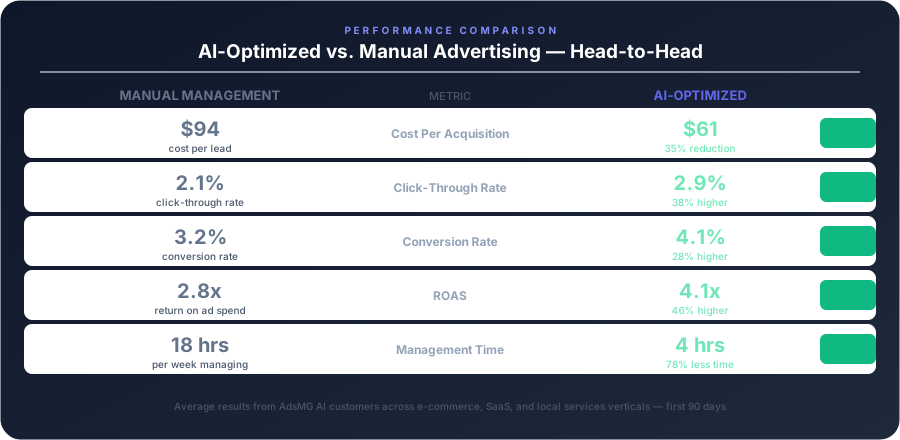
The typical outcome for an e-commerce brand with this profile using AdsMG.ai: ROAS improves to 3.9–4.5x within 90 days, campaign management time drops from 20+ hours/week to 4–6 hours. HubSpot can track which ad-attributed contacts are in the pipeline, but it can’t optimize the ads themselves.
Verdict: AdsMG.ai handles the paid media performance; optionally add HubSpot for CRM and lifecycle email.
Scenario 2: B2B SaaS, Inbound-Led Growth Strategy
Goal: Generate organic leads through content, nurture them through email sequences, track pipeline in a CRM.
Best platform: HubSpot
This is HubSpot’s ideal use case. The full Marketing Hub + CRM combination is purpose-built for inbound-led B2B growth. Blog CMS, SEO tools, landing pages, email automation, and CRM in one platform with native data flow between them.
AdsMG.ai can complement this for paid campaigns (particularly LinkedIn and Google Search targeting high-intent keywords), but the core inbound/nurture motion is HubSpot’s domain.
Verdict: HubSpot as the primary platform; AdsMG.ai as a paid media complement for lead acquisition.
Scenario 3: Local Service Business, $10K/Month Ad Spend
Goal: More leads at lower cost per lead, simpler campaign management, no in-house marketing team.
Best platform: AdsMG.ai
Local service businesses typically don’t need a CRM at HubSpot’s level of complexity — many use simpler tools like Jobber, ServiceTitan, or even a spreadsheet for pipeline management. What they do need is better advertising efficiency, which is exactly what AdsMG.ai delivers.
The AI-powered local targeting, bid optimization, and creative testing in AdsMG.ai is extremely well-suited to local service advertising — Google Search, Local Services Ads, Meta, all managed from one dashboard.
Verdict: AdsMG.ai with a simpler CRM purpose-built for field service businesses.
Scenario 4: Mid-Size Marketing Agency Managing Multiple Client Accounts
Goal: Manage paid media across 20+ clients, report performance to clients, scale operations efficiently.
Best platform: AdsMG.ai (with HubSpot for agency CRM)
Agencies need advertising performance at scale, not inbound marketing for themselves. AdsMG.ai’s multi-account management capability and automated reporting makes it well-suited for agencies.
HubSpot is useful for managing the agency’s own pipeline and client relationships — but as the CRM layer, not the advertising tool.
Verdict: AdsMG.ai for client campaign management; HubSpot for agency-own business development.
Pricing Comparison: Total Cost of Ownership
When comparing platforms, monthly subscription cost is only part of the equation. Consider total cost of ownership over 12 months:
AdsMG.ai Total Cost of Ownership:
- Platform subscription: competitive monthly fee
- Setup time: typically 1–3 days (AI-guided setup)
- Training requirement: minimal (designed for marketers, not technical specialists)
- No percentage-of-ad-spend fees
- Value delivered: measurable CPA reduction and ROAS improvement that typically 10–20x the platform cost
HubSpot Total Cost of Ownership:
- Platform subscription: $0–$3,600+/month depending on tier and hubs selected
- Setup time: 2–8 weeks for a full Marketing + CRM implementation
- Training requirement: moderate — HubSpot’s broad feature set takes time to master
- Contact database costs increase as your list grows
- Onboarding fee: HubSpot often charges $3,000–$5,000 for professional onboarding at Professional/Enterprise tier
For a small business primarily needing ad performance improvement, HubSpot Professional ($890+/month) represents significant overhead for features that aren’t central to the core use case. AdsMG.ai delivers more focused ROI for the paid advertising use case at a lower price point.
Migration Guide: Moving Between Platforms
Moving from HubSpot to AdsMG.ai (for ad management):
- Connect your ad accounts (Google, Meta, LinkedIn) to AdsMG.ai
- Export your contact list from HubSpot and upload as a seed audience
- Map your existing campaigns into AdsMG.ai (or start fresh with AI-recommended structure)
- Keep HubSpot for CRM/email if you use it for those functions
Moving from manual ad management to AdsMG.ai:
- Connect ad accounts
- Set your campaign goals and budget
- Upload existing creative assets and brand guidelines
- Launch — AI handles the rest within 1–2 hours
Adding AdsMG.ai to an existing HubSpot setup: The two platforms complement each other without overlap. AdsMG.ai handles paid media performance; HubSpot handles CRM and inbound. You can pass AdsMG.ai audience data into HubSpot contacts and track ad-attributed contacts through the HubSpot pipeline.
Customer Perspectives
AdsMG.ai customers typically report:
“We cut our cost per lead from $94 to $58 in 6 weeks. The AI does what used to take our team 15 hours a week of manual optimization.” — E-commerce retailer
“We were skeptical about handing campaign management to AI. But after 90 days the data was undeniable — ROAS improved 40% and we’re spending less time managing campaigns than ever.” — Marketing director, DTC brand
HubSpot customers typically report:
“HubSpot gave us a single place to see every touchpoint a prospect had before they became a customer. Our sales team finally has the context they need to close deals.” — VP Marketing, B2B SaaS
“The inbound machine we built with HubSpot generates 60% of our leads organically. It took 6 months to build, but now it runs itself.” — Growth marketer, professional services
Summary
AdsMG.ai and HubSpot aren’t really competitors — they’re complementary tools that excel in different areas of the marketing stack.
If your bottleneck is paid advertising performance — ROAS, CPA, creative testing, multi-platform campaign management — AdsMG.ai is the specialized tool you need.
If your bottleneck is CRM, inbound marketing, and customer lifecycle management, HubSpot is a category leader.
Many successful marketing teams use both: HubSpot as their CRM and inbound hub, AdsMG.ai as their paid media engine.
Frequently Asked Questions: AdsMG.ai vs HubSpot
Can I use AdsMG.ai and HubSpot together? Yes, and this is actually a common setup for mature marketing teams. AdsMG.ai handles paid media performance; HubSpot manages CRM, inbound content, and email automation. You can pass AdsMG.ai-attributed leads into HubSpot for lifecycle management.
Does HubSpot replace the need for AdsMG.ai? No. HubSpot’s ad management features are designed for tracking and reporting on ad-attributed contacts — not for optimizing campaign performance. HubSpot cannot manage bids, test copy variants, or auto-optimize budgets the way AdsMG.ai does. They serve fundamentally different functions.
Does AdsMG.ai replace the need for HubSpot? For businesses whose primary marketing function is paid advertising, yes. Many performance-focused businesses use AdsMG.ai for campaign management and a simpler CRM (Pipedrive, Close, even a spreadsheet) for contact management — without needing HubSpot’s full feature set.
Which platform has better customer support? Both offer strong support. HubSpot has a large knowledge base, HubSpot Academy, and a community forum built over years. For advertisers specifically, AdsMG.ai’s support team is focused on paid media performance — a more specialized scope.
Is HubSpot free? HubSpot has a free tier with meaningful limitations. The features most relevant to marketing automation, A/B testing, and SEO are gated behind Professional ($890+/month) or Enterprise ($3,600+/month) plans. The free plan is useful for getting started but not sufficient for most growing businesses’ marketing needs.
Is AdsMG.ai free? AdsMG.ai offers a free trial. Paid plans are competitively priced with no percentage-of-ad-spend fees — meaning your platform cost stays predictable regardless of how much you scale your advertising.
Can AdsMG.ai help with email marketing? AdsMG.ai’s primary focus is paid advertising performance. For email marketing, you’ll want a dedicated email tool (Klaviyo, ActiveCampaign, HubSpot). AdsMG.ai and email marketing platforms are complementary: ad campaigns drive traffic, email marketing converts and retains.
Which platform has better analytics? Different analytics for different purposes. HubSpot’s analytics are excellent for understanding the customer journey across inbound touchpoints — which blog posts drive leads, which email sequences convert, how pipeline is progressing. AdsMG.ai’s analytics are purpose-built for advertising performance — ROAS, CPA, creative performance, bid efficiency, and cross-channel attribution. You likely want both for a complete view.
Is HubSpot or AdsMG.ai better for agencies? For agencies managing paid media for clients, AdsMG.ai’s multi-account management and automated client reporting is the better fit. HubSpot has an agency program but is more suited to agencies building inbound campaigns for clients, not managing paid media performance.
Final Verdict
Most businesses don’t need to choose once and never revisit. Marketing stacks evolve as businesses grow. Start with the platform that solves your most urgent problem today. Add the other when it becomes the next constraint.
If you’re trying to choose between AdsMG.ai and HubSpot, the question to answer is: what is your biggest growth lever right now?
- Paid advertising performance → AdsMG.ai
- Inbound marketing, CRM, sales pipeline → HubSpot
- Both, in a mature full-funnel operation → Use both, they integrate
Neither platform is “better” in an absolute sense. They’re built for different problems. Choose the one that solves your most pressing problem, do that well, and add the other when it becomes the next bottleneck. The businesses that treat this as an either/or choice often under-invest in one area; the businesses that use both strategically cover the full funnel more effectively than either platform could alone.
See how AdsMG.ai can improve your paid advertising performance. Start free →
Common Mistakes When Choosing Between AdsMG AI and HubSpot
Buying HubSpot for the ads features. HubSpot’s ad management is designed to attribute and track campaigns, not to optimize them. If your primary goal is improving advertising performance, you need a dedicated AI advertising platform — HubSpot won’t deliver the AI bidding, creative testing, or cross-channel optimization you need.
Assuming more features = better results. HubSpot’s breadth is its strength and weakness. Teams that buy the full platform but only use 20% of its features pay enterprise prices for SMB outcomes. Be honest about which features you’ll actually use before committing to annual contracts.
Neglecting your existing CRM when switching. If your sales team already lives in a CRM (Salesforce, Pipedrive, etc.), adding HubSpot creates data silos. Consider integration complexity before choosing a platform that duplicates existing infrastructure.
Under-budgeting for HubSpot implementation. HubSpot typically requires 40-80 hours of setup and integration work to run properly. Factor in this onboarding investment when comparing costs to simpler, purpose-built tools.
Using AdsMG AI as a reporting tool only. AdsMG AI’s value comes from its AI optimization — set goals and let the AI manage bidding, creative testing, and budget allocation. Treating it as a dashboard while manually managing campaigns underutilizes the platform significantly.
AdsMG AI Team — AI marketing specialists with hands-on experience managing $10M+ in annual ad spend across Google, Meta, LinkedIn, and programmatic channels. AdsMG AI has helped 500+ businesses reduce cost-per-acquisition by an average of 32% through AI-powered advertising automation. Every article is written or reviewed by practitioners who run real campaigns with real budgets. Learn more about AdsMG AI →
Related Resources
- AdsMG.ai vs Jasper: Full Comparison 2026 — how AdsMG compares to Jasper for ad copywriting
- 50 Best AI Tools for Small Businesses in 2026 — full curated directory
- Free AI Ad Copy Generator — try AdsMG’s core feature free, no signup required
- Free AI ROI Calculator — calculate your potential return from switching platforms
Frequently Asked Questions
Use these answers as the quick-reference layer for common objections, buying questions, and implementation concerns.
Is AdsMG AI better than HubSpot for paid advertising?+
AdsMG AI is purposebuilt for AIpowered paid advertising optimization, while HubSpot is primarily a CRM and inbound marketing platform. For running and optimizing Google, Meta, and other paid ad campaigns, AdsMG AI's AI bidding, crosschannel optimization, and automated creative testing give it a significant edge over HubSpot's more basic ads tools.
Does HubSpot have AI advertising features?+
HubSpot includes basic AI features like content suggestions, email optimization, and some predictive analytics. However, its advertising capabilities are primarily focused on campaign tracking and attribution rather than AIdriven bidding optimization. HubSpot connects to ad platforms but doesn't provide the deep optimization layer that dedicated AI advertising tools offer.
Can I use AdsMG AI and HubSpot together?+
Yes. Many businesses use HubSpot for CRM and inbound marketing while using AdsMG AI for paid advertising optimization. The two tools complement each other: HubSpot manages leads and customer relationships, while AdsMG AI maximizes the performance of your paid acquisition channels.
What is the pricing difference between AdsMG AI and HubSpot?+
HubSpot's Marketing Hub starts at $45/month (Starter) and scales to $800+/month (Professional) and $3,600+/month (Enterprise). AdsMG AI is generally more affordable for teams focused primarily on ad optimization rather than the full CRM and marketing stack. Check current pricing at adsmg.ai.
Which tool is better for small businesses?+
For small businesses running paid ads, AdsMG AI typically offers more value per dollar since you're paying specifically for ad optimization rather than a broad marketing platform. If your business relies heavily on inbound content marketing, email sequences, and CRM workflows, HubSpot's broader feature set may justify the cost.
Turn the ideas in this article into live campaigns, content, and creative tests.
AdsMG AI helps growth teams move from strategy to execution without stitching together separate tools for copy, optimization, and reporting.