Top 15 AI tools for e-commerce — quick comparison:
| Tool | Category | Best For | Free Tier | Starting Price |
|---|---|---|---|---|
| AdsMG AI | Ad copy & optimization | Google, Meta, TikTok ads | Yes | $0 |
| Klaviyo | Email & SMS | Behavioral email flows | Yes | $20/mo |
| Yotpo | Reviews & loyalty | UGC and social proof | Yes | $15/mo |
| Nosto | Personalization | Product recommendations | No | Custom |
| Triple Whale | Analytics | ROAS & attribution | No | $129/mo |
| Jasper | Content | Product descriptions at scale | Trial | $39/mo |
| Tidio | Chat & support | AI customer service chatbot | Yes | $29/mo |
| Gorgias | Helpdesk | AI support ticket automation | No | $10/mo |
| Rebuy | Product recommendations | Cart upsells & cross-sells | No | $99/mo |
| Aislelabs | In-store analytics | Foot traffic & behavior | No | Custom |
| Smartly.io | Paid social | Automated creative production | No | Custom |
| Omnisend | Email & SMS | E-commerce automation | Yes | $16/mo |
| Searchie | Video | AI video content for products | No | $65/mo |
| Daasity | Data & BI | Unified e-commerce reporting | No | $99/mo |
| Wiser | Dynamic pricing | AI price optimization | No | Custom |
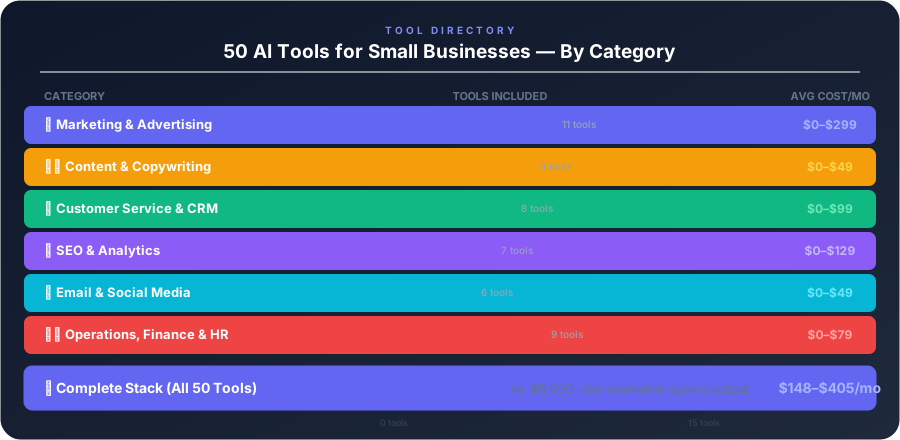
E-commerce marketing is one of the highest-leverage applications of AI available. The combination of rich behavioral data, fast testing cycles, and measurable conversion outcomes makes it ideal for AI optimization.
This list ranks the 15 best AI tools for e-commerce marketing based on ROI impact, ease of integration, and the specific problems they solve.
How We Ranked These Tools
Each tool was evaluated on:
- ROI documentation — Is there real performance data, not just marketing claims?
- E-commerce specificity — Does this tool understand the e-commerce use case?
- Integration quality — How well does it work with Shopify, WooCommerce, Magento, and other platforms?
- Price-to-value — Is the ROI accessible for businesses under $10M/year in GMV?
The 15 Best AI Tools for E-Commerce Marketing
1. AdsMG AI — Best AI for E-Commerce Advertising
AdsMG AI is the top choice for e-commerce businesses running paid advertising across multiple channels. The platform autonomously manages campaigns across Google Shopping, Meta catalog ads, dynamic retargeting, and prospecting — optimizing bids, creative, and audiences in real time.
Why it leads for e-commerce:
- Catalog-based campaign management: feeds your product catalog to create and optimize product-level ads
- Dynamic creative optimization automatically shows the most relevant products to each user
- Cross-channel attribution connects Meta awareness spend to Google search conversions
- No percentage-of-spend pricing — costs don’t scale with your ad budget
Best for: Any e-commerce brand spending $2,000+/month on paid advertising Key result: Brands typically see 20–40% improvement in ROAS within 60 days Try AdsMG AI →
2. Klaviyo — Best AI for E-Commerce Email and SMS
Klaviyo is the gold standard for e-commerce email and SMS marketing. Its AI features include predictive customer lifetime value (CLV), churn prediction, optimal send-time calculation, and AI-generated SMS copy.
Standout AI features:
- Predictive CLV: Score customers by expected future value and segment accordingly
- Win-back automation: AI identifies customers likely to churn and triggers campaigns before they leave
- Smart send time: Each contact receives emails at their personal highest-engagement time
- Product recommendations: AI surfaces the most relevant products for each customer in emails
Best for: E-commerce businesses with 1,000+ email subscribers Integration: Native Shopify, WooCommerce, and BigCommerce integrations Pricing: Free up to 500 contacts; scales by list size
3. Nosto — Best AI for On-Site Personalization
Nosto is the leading AI personalization platform for e-commerce, used by thousands of online retailers to deliver dynamic homepage experiences, product recommendations, and pop-ups personalized to each visitor.
AI capabilities:
- Real-time behavioral analysis and session profiling
- AI product recommendations based on browsing, purchase history, and similar visitors
- Personalized search results (shows most relevant products first for each user)
- Dynamic popups and overlays triggered by predicted exit intent or engagement signals
- A/B testing with AI-powered winner selection
Best for: E-commerce stores with 5,000+ monthly visitors Typical impact: 10–25% increase in revenue per visitor
4. Gorgias with AI — Best AI for E-Commerce Customer Service
Gorgias is the top customer service platform built specifically for e-commerce. Its AI automation handles repetitive tickets (order status, return requests, basic FAQs) and routes complex issues to human agents with full context.
AI features:
- Auto-close routine tickets (up to 30% of ticket volume)
- Sentiment detection flags frustrated customers for priority handling
- AI-suggested responses for agents speed up resolution time
- Order data pulls from Shopify so AI can answer “where is my order” instantly
Best for: E-commerce stores with 50+ support tickets/day Integration: Deep Shopify and BigCommerce integration
5. Triple Whale — Best AI for E-Commerce Analytics and Attribution
Triple Whale is purpose-built for DTC e-commerce analytics. It consolidates data from all ad platforms, Shopify, and post-purchase surveys into a single dashboard, with AI-powered attribution models and incrementality measurement.
AI features:
- Pixel-based first-party attribution tracks customer journeys with reduced reliance on third-party cookies
- AI attribution models compare last-click, linear, and time-decay attribution simultaneously
- Predictive ROAS for campaign planning
- Cohort analysis AI identifies which acquisition channels bring the highest-LTV customers
Best for: DTC brands spending $20K+/month on ads who need accurate attribution Integration: Shopify, Facebook, Google, TikTok, Klaviyo
6. Rebuy — Best AI for E-Commerce Upsell and Cross-Sell
Rebuy builds AI-powered upsell and cross-sell experiences at every touchpoint in the Shopify checkout flow: product page widgets, cart recommendations, post-purchase offers, and reorder reminders.
AI capabilities:
- Trained on your store’s purchase history to identify best-performing product combinations
- Smart cart: dynamically adjusts recommendations based on what’s in the cart
- Post-purchase one-click upsells served immediately after checkout completion
- Reorder engine: predicts when subscription or consumable customers are likely to need replenishment
Best for: Shopify brands with 3+ products and 500+ monthly orders Typical impact: 15%+ increase in average order value
7. Recart — Best AI for E-Commerce SMS Marketing
Recart specializes in AI-powered SMS marketing for e-commerce with a focus on abandoned cart recovery and post-purchase flows. Its conversational SMS flows use AI to personalize messages and optimize send timing.
AI features:
- Abandoned cart recovery with personalized product mentions
- AI-optimized send timing by subscriber segment
- Behavioral triggers (browse abandonment, back-in-stock, price drop)
- AI copy variants tested automatically
Best for: E-commerce brands with existing SMS list or looking to build one Best use case: Cart recovery (typical 8–15% recovery rate)
8. Searchie / Boost Commerce — Best AI for E-Commerce Site Search
On-site search is one of the highest-converting pages in e-commerce — shoppers who search have strong intent. Boost Commerce adds AI-powered search autocomplete, synonym recognition, and personalized results that adapt to each user’s browsing history.
AI features:
- Semantic search: understands intent, not just keywords (searches for “running shoe” return relevant results even if products don’t use that exact phrase)
- Personalized ranking: returning customers see results tailored to their purchase history
- AI merchandising: boost new products or margin-rich SKUs in search results
Best for: E-commerce stores with 200+ SKUs
9. Retention.com — Best AI for E-Commerce Visitor Identification
Retention.com identifies anonymous website visitors using its email matching network, then triggers automated email sequences for abandon events — reaching shoppers who never made it to your email capture.
AI capabilities:
- Identifies 10–40% of anonymous visitors by matching browser data to email addresses
- AI send-time optimization and segmentation for outreach sequences
- Browse abandonment, cart abandonment, and checkout abandonment flows
Best for: E-commerce brands with significant traffic but low email capture rates
10. Aftership — Best AI for Post-Purchase Experience
Aftership’s AI powers the post-purchase experience: personalized tracking pages, proactive delivery notifications, and AI-driven product recommendations on tracking pages (turning a transactional page into a revenue opportunity).
AI features:
- Predictive delivery date estimates with real-time carrier data
- AI anomaly detection flags at-risk shipments before customers complain
- Personalized product recommendations on tracking pages drive repeat purchases
- AI-generated proactive notifications reduce “where is my order” tickets
Best for: Any e-commerce brand shipping physical products Integration: Shopify, WooCommerce, Magento
11. Yotpo — Best AI for E-Commerce Reviews and Loyalty
Yotpo combines AI-powered reviews collection, loyalty programs, and SMS/email into a single platform. AI determines optimal review request timing, identifies best advocates for referral campaigns, and personalizes loyalty point reminders.
AI features:
- Smart review request timing (sends when customers are most likely to respond positively)
- Sentiment analysis surfaces product issues in reviews before they escalate
- AI-identified loyalty advocates automatically enrolled in referral programs
Best for: Brands where social proof and repeat purchase rate are key metrics
12. Daasity — Best AI for E-Commerce Business Intelligence
Daasity is an AI analytics platform designed for DTC and e-commerce brands. It connects all your data sources (Shopify, ads, email, Amazon) and provides AI-generated insights, automated reports, and predictive forecasts.
AI features:
- Automated anomaly detection: alerts when a metric moves outside expected range
- Predictive inventory and demand forecasting
- Customer segmentation AI builds behavioral cohorts automatically
- AI-generated weekly business reviews
Best for: E-commerce brands with $1M+ GMV who need analytics beyond Shopify dashboard
13. Okendo — Best AI for E-Commerce Social Proof Automation
Okendo automates the collection and distribution of reviews, Q&A, and UGC using AI. Standout feature: AI-powered review summary widgets that display AI-generated summaries of review sentiment by product attribute (comfort, quality, sizing, etc.).
AI features:
- AI review summaries reduce friction for shoppers evaluating products
- Automated review collection with personalized email sequences
- AI attribute extraction from review text (automatically tags “sizing runs small” across reviews)
Best for: Apparel, beauty, and consumer goods brands
14. LoyaltyLion — Best AI for E-Commerce Customer Retention
LoyaltyLion’s loyalty program platform uses AI to identify at-risk customers and trigger targeted loyalty campaigns before they churn. The AI engine determines the optimal reward incentive for each customer segment.
AI features:
- Churn prediction flags customers showing disengagement signals
- Dynamic reward offers: AI determines the minimum incentive needed to trigger a purchase
- RFM-based segmentation with AI-powered micro-segment targeting
Best for: E-commerce brands with 500+ repeat purchase customers
15. Omnisend — Best AI for Omnichannel E-Commerce Marketing
Omnisend combines email, SMS, push notifications, and Facebook retargeting in one platform with AI-powered automation across all channels. More affordable than Klaviyo for growing brands; strong automation builder.
AI features:
- AI product recommendations in emails using purchase history
- Smart segmentation identifies high-value subscriber segments automatically
- Cross-channel send-time optimization
- Abandoned cart sequence AI determines optimal timing and incentive
Best for: Growing e-commerce brands that want multi-channel marketing in one tool Pricing: Free tier available; competitive pricing vs. Klaviyo
How to Build Your E-Commerce AI Marketing Stack
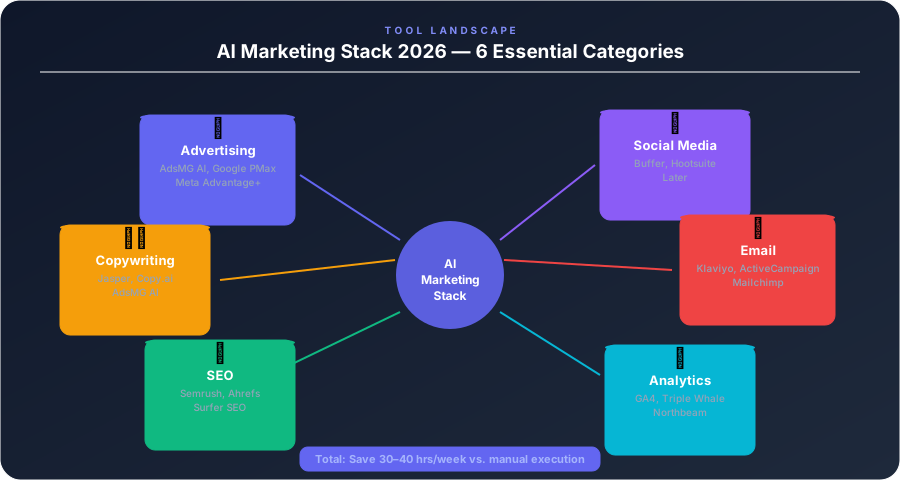
Most e-commerce businesses should build their stack in this priority order:
Foundation (start here):
- AI advertising (AdsMG AI) — highest immediate ROI
- Email/SMS AI (Klaviyo or Omnisend) — highest retention ROI
- Analytics (Triple Whale) — necessary to measure everything else
Growth layer (add when scaling): 4. On-site personalization (Nosto or Rebuy) — boosts conversion and AOV 5. Customer service AI (Gorgias) — manages support volume as you scale
Optimization layer: 6. Reviews and loyalty (Yotpo or Okendo + LoyaltyLion) 7. Post-purchase experience (Aftership) 8. Advanced analytics (Daasity)
Don’t add tools faster than you can measure them. Each addition to your stack should have a defined metric it’s supposed to move and a timeline for evaluating impact.
Frequently Asked Questions
Q: Which AI tool has the fastest ROI for e-commerce? AI advertising optimization (AdsMG AI) typically shows measurable ROI within 30–60 days because it directly improves revenue per dollar of ad spend. Abandoned cart email and SMS flows (Klaviyo, Recart) also recover revenue quickly.
Q: Do I need all 15 tools? No. Start with 2–3 that address your biggest bottlenecks. Over-tooling creates integration complexity and splits your measurement capacity. A focused 3-tool stack well-implemented outperforms a scattered 10-tool stack.
Q: Are these tools only for large e-commerce brands? Most of the tools on this list are accessible to brands doing $500K+ in annual revenue. AdsMG AI, Omnisend, and Klaviyo all have plans accessible to smaller brands.
How to Choose the Right AI Tools for Your E-Commerce Stage
Not every e-commerce business needs the same AI tools. Here’s a framework for selecting the right stack at each growth stage:
Stage 1: Launch ($0-$5K monthly revenue)
Focus on AI tools that are free or low-cost and address the biggest bottlenecks — typically content creation and basic advertising setup.
Recommended stack:
- Advertising: Google Smart Bidding (free, built into Google Ads)
- Content: ChatGPT free tier (product descriptions, ad copy)
- Email: Klaviyo free plan (up to 250 contacts)
- Analytics: Google Analytics 4 (free)
- Total: $0/month
At this stage, AI tools should help you produce professional-quality content and run basic campaigns without the cost of hiring specialists.
Stage 2: Growth ($5K-$50K monthly revenue)
You’re generating enough revenue and conversion data for AI to optimize meaningfully. Priority shifts to AI advertising optimization and email personalization.
Recommended stack:
- Advertising: AdsMG AI ($49-199/month) — AI bidding + cross-channel optimization
- Email: Klaviyo ($20-150/month depending on list size) — AI send time + personalization
- SEO: SEMrush Starter ($99/month) — keyword research + content ideas
- Total: $170-450/month
At this stage, advertising and email ROI should easily cover tool costs within 30-60 days.
Stage 3: Scale ($50K+ monthly revenue)
At this stage, on-site personalization and LTV modeling become ROI-positive. Complex segmentation and predictive analytics provide competitive advantages.
Recommended stack:
- Advertising: AdsMG AI Pro + Google Performance Max
- Email: Klaviyo Growth + SMS
- Personalization: Nosto or Dynamic Yield ($500-1,000/month)
- Analytics: Triple Whale ($99-499/month) — multi-touch attribution
- Reviews: Yotpo or Okendo ($50-300/month)
- Total: $750-2,000/month
At scale, the 2-4% conversion rate improvement from personalization alone generates $1,000-2,000/month in added revenue for every $1M in annual revenue.
E-Commerce AI Marketing Tools: Feature Comparison
| Tool | Primary Function | AI Capabilities | Price Range | Best For |
|---|---|---|---|---|
| AdsMG AI | Paid advertising | Bidding, creative testing, budget allocation | $49-499/mo | All-stage ad management |
| Klaviyo | Email + SMS | Send time, personalization, predictive segments | $20-1,400/mo | E-commerce email |
| Nosto | On-site personalization | Product recommendations, pop-ups | $500-1,500/mo | Mid-market stores |
| Google Performance Max | Google ads | Cross-channel AI optimization | Free (pay for clicks) | Google channel leaders |
| Triple Whale | Analytics | Attribution, LTV modeling, cohort analysis | $129-499/mo | Multi-channel analytics |
| Yotpo | Reviews + UGC | Review request timing, UGC curation | $15-400/mo | Social proof automation |
| ChatGPT / Claude | Content creation | Copy generation, variation testing | $0-20/mo | Content at all stages |
| Surfer SEO | SEO optimization | Content scoring, keyword clustering | $79-219/mo | SEO-focused stores |
Common Mistakes E-Commerce Businesses Make With AI Marketing Tools
Buying AI tools before fixing conversion tracking. AI advertising tools optimize toward the conversion events you track. If your tracking is broken, missing, or measuring the wrong events, AI will optimize toward the wrong outcomes. Fix conversion tracking before investing in AI optimization — it’s the most important prerequisite.
Expecting AI to work without sufficient data. AI recommendation engines need transaction history. AI bidding needs conversion data. AI email tools need behavioral data. Businesses launching new stores often expect immediate AI benefits when AI needs weeks or months of data to learn from.
Over-personalizing to the point of being creepy. Hyper-personalization that surfaces very specific behavioral data can make customers uncomfortable. Balance personalization with privacy expectations — show relevant products, not surveillance-level targeting. Test personalization depth with your specific audience.
Neglecting mobile experience. Over 60% of e-commerce traffic is mobile. AI tools that optimize for conversion without considering mobile UX often improve desktop metrics while mobile remains broken. Always segment AI performance analysis by device.
Using AI for discovery and not retention. Most e-commerce businesses focus AI on customer acquisition. AI-powered email personalization, post-purchase sequences, and loyalty programs typically deliver 3-5x higher ROI than acquisition-focused AI tools. Balance your AI investment between acquiring and retaining customers.
Not integrating ad data with your CRM or email platform. AI advertising performs best when your ad platforms have access to customer data — email lists for custom audiences, purchase history for product targeting, LTV data for bid optimization. Integrate your tools or you’re leaving significant optimization potential on the table.
AdsMG AI Team — AI marketing specialists with hands-on experience managing $10M+ in annual ad spend across Google, Meta, LinkedIn, and programmatic channels. AdsMG AI has helped 500+ businesses reduce cost-per-acquisition by an average of 32% through AI-powered advertising automation. Every article is written or reviewed by practitioners who run real campaigns with real budgets. Learn more about AdsMG AI →
Related Resources
- AI Marketing for E-Commerce: 12 Tactics That Work in 2026 — the complete e-commerce AI playbook
- Free AI Ad Copy Generator — generate product ad copy for Google, Meta, and TikTok instantly
- Free AI Social Media Post Generator — create platform-optimized product posts with hashtags
- Free AI Content Calendar Planner — plan your promotions across channels
Ready to see AdsMG AI improve your e-commerce ad performance? Start your free trial →
Local Service Blueprint: Performance Marketing for E-Commerce Brands in Mumbai
Mumbai-based DTC brands will find our performance marketing blueprint useful — covering Meta Conversions API setup, CAC benchmarks by category (fashion ₹350–900, beauty ₹200–600), the full 8-week Diwali preparation framework, and the ONDC opportunity for owned-channel growth: Performance Marketing for E-Commerce Brands in Mumbai.
Frequently Asked Questions
Use these answers as the quick-reference layer for common objections, buying questions, and implementation concerns.
What are the best AI tools for ecommerce marketing in 2026?+
The best AI ecommerce marketing tools in 2026 are: AdsMG AI (paid advertising), Klaviyo (email and SMS), Google Performance Max (search and shopping ads), Nosto (onsite personalization), Jasper (content creation), and SEMrush (SEO and competitor analysis). The right stack depends on your budget and primary growth channels.
Is there a free AI tool for ecommerce marketing?+
Yes. Several powerful AI ecommerce marketing tools are free or have free tiers: Google's AI bidding is built into Google Ads at no extra cost; Klaviyo's free plan handles up to 250 contacts; many AI content tools offer free trials; and tools like AdsMG AI often have free starter options.
How do I choose the right AI marketing tool for my ecommerce store?+
Choose based on your biggest growth opportunity: if you rely on paid ads, prioritize AI advertising optimization. If email drives most revenue, focus on AI email tools. If organic search is your channel, invest in AI SEO tools. Start with one tool, prove ROI, then expand your stack.
What AI tools does Amazon use for ecommerce marketing?+
Amazon uses proprietary AI systems including its recommendation engine (which drives 35% of purchases), dynamic pricing algorithms, A9/A10 search ranking algorithms, and AIpowered logistics optimization. While these specific systems aren't available externally, similar capabilities are accessible through platforms like Klaviyo, Google, and AdsMG AI.
How much should an ecommerce business spend on AI marketing tools?+
A typical ecommerce business should budget 515% of its marketing software budget for AI tools. In practice, this often means $50500/month depending on business size. The key metric is ROI — most AI tools for ecommerce deliver 310x return on software cost through improved conversion rates and lower acquisition costs.
Turn the ideas in this article into live campaigns, content, and creative tests.
AdsMG AI helps growth teams move from strategy to execution without stitching together separate tools for copy, optimization, and reporting.