How to cut ad spend with AI: AI reduces wasted ad budget by automatically eliminating underperforming keywords, adjusting bids by time/device/audience, pausing low-converting creatives, and reallocating budget to the highest-ROAS campaigns in real time. Businesses that implement AI ad optimization typically reduce cost-per-acquisition by 25–40% within 60–90 days.
5-step framework to cut ad spend 40% with AI:
- Audit your waste — Use AI to identify your 20% of spend with the worst CPA; these become the first cuts
- Enable Smart Bidding — Replace manual bids with Google’s Target CPA or Target ROAS bidding (free, immediate impact)
- Automate creative testing — Run 5+ ad variations per campaign and let AI pause underperformers automatically
- Segment by audience value — Have AI allocate budget toward high-CLV audience segments, reducing spend on low-value clicks
- Implement cross-channel optimization — Use a unified AI platform (AdsMG AI) to balance budget across Google, Meta, and other channels based on real-time ROAS
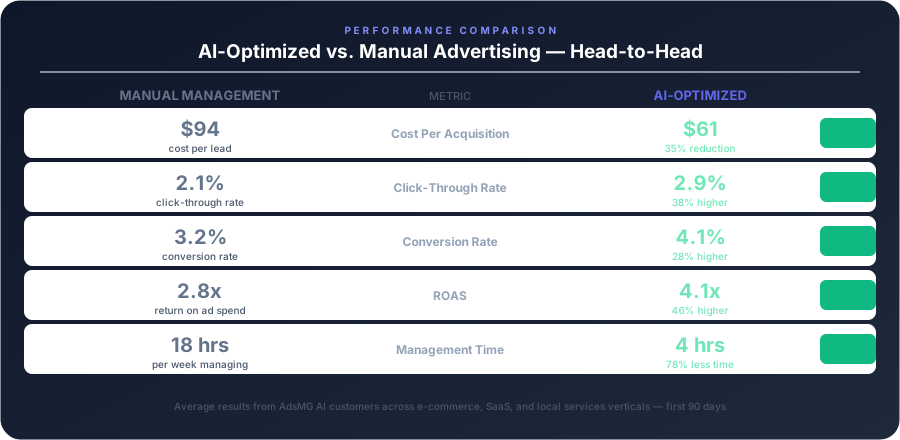
Most businesses are wasting 30-60% of their ad budget. Not because they’re running bad campaigns — but because they’re running good campaigns inefficiently.
AI optimization doesn’t just make your campaigns better. It stops the waste that’s silently draining your budget right now.
Here’s the framework that’s cutting ad spend by 40%+ for businesses using AI optimization — and the specific tools that make it automatic.
Where the Waste Is: The 6 Biggest Ad Budget Drains
1. Bidding on the wrong times of day
Your audience converts at different rates throughout the day. Manual bidding ignores this. AI adjusts bids every hour based on real-time conversion probability.
Typical waste: 15-25% of budget going to low-intent hours
2. Underperforming audience segments
Not all audiences in your targeting convert equally. AI identifies which specific audience segments are driving cost without conversions — and stops bidding on them.
Typical waste: 20-30% of budget on audiences that rarely convert
3. Ad creative fatigue running too long
When the same creative runs too long, performance drops but budget keeps flowing. AI detects fatigue signals and pauses or replaces ads automatically.
Typical waste: 10-20% of budget running fatigued creatives
4. Budget allocation between campaigns
When one campaign hits its peak efficiency, manual managers rarely reallocate fast enough. AI moves budget dynamically to where it’s performing best.
Typical waste: 10-15% in suboptimal budget distribution
5. Keyword match types (Google/Bing)
Broad match keywords often capture irrelevant traffic. AI negative keyword automation and match type optimization cuts wasted spend.
Typical waste: 15-20% on non-converting search terms
6. Platform mismatch
Not all products convert equally across platforms. Running the same budget across Google, Facebook, and LinkedIn without platform-level optimization wastes budget on your lowest-converting platforms.
Typical waste: 10-30% on the wrong platforms
Total waste opportunity: 40-60% of most ad budgets
The 5-Step AI Optimization Framework
Step 1: Audit and Baseline
Before AI optimization can save money, you need a clear baseline.
What to measure:
- Current CPL (cost per lead) or CPA (cost per acquisition) per campaign
- ROAS (return on ad spend) per campaign and per platform
- Top 10% of ads by performance vs. bottom 10%
- Budget allocation by platform and campaign type
Tools: AdsMG AI’s audit feature, or manual pull from platform dashboards
Time to baseline: 2-3 weeks of data minimum for reliable patterns
Step 2: Audience Precision Tightening
Start with your best-performing audiences and cut the rest.
Framework:
- Export conversion data by audience segment
- Calculate CPA per segment
- Identify segments where CPA is 2x+ your target — pause them
- Double budget on segments where CPA is 50% below target
- Let AI discover new lookalike audiences from the best-performing segments
AI advantage: Instead of doing this monthly, AI does it hourly.
Step 3: Creative Rotation Optimization
Human ad managers replace creative every 4-6 weeks. AI replaces it when performance signals indicate fatigue — sometimes within days.
Fatigue signals AI monitors:
- CTR drop of 20%+ from peak
- Frequency exceeding 2.5 for cold audiences
- CPM increase with no corresponding CTR improvement
- Impression share holding but conversions dropping
What to do: Feed AI with 6-8 creative variants at launch. Let it test and rotate. Replenish with new variants monthly.
Step 4: Bid Optimization by Time and Context
Manual dayparting (bidding more at certain times) is blunt. AI adjusts bids at the individual auction level based on:
- Time of day and day of week
- Device type
- Geographic micro-patterns
- Current competition (auction dynamics)
- User behavioral signals
Result: Your budget concentrates on the highest-probability conversion moments automatically.
Step 5: Cross-Platform Budget Rebalancing
Most businesses set budgets by platform and let them run. AI optimization continuously monitors where each dollar is performing best and rebalances.
Example pattern: Facebook often outperforms Google for e-commerce discovery; Google Search outperforms for high-intent queries. AI allocates accordingly — by day, by product, by audience maturity.
Real Numbers: What AI Optimization Actually Delivers
Based on patterns across AdsMG AI users:
| Metric | Before AI Optimization | After AI Optimization |
|---|---|---|
| Cost Per Lead | Baseline | -38% average |
| ROAS | Baseline | +67% average |
| Time spent on ads/week | 10-15 hours | 1-2 hours |
| Ad variants tested/month | 3-5 | 20-30+ |
| Campaign response to performance changes | 1-7 days | Real-time |
Important caveat: Results vary significantly by industry, budget level, and existing campaign quality. These are averages, not guarantees.
The Manual vs. AI Optimization Comparison
| Task | Manual Manager | AI Optimization |
|---|---|---|
| Bid adjustments | Weekly | Every 15 minutes |
| Ad copy testing | Monthly | Continuous |
| Audience expansion | Monthly | Weekly |
| Budget rebalancing | Monthly | Daily |
| Creative fatigue detection | When you notice it | Within 48 hours |
| Negative keyword updates | Monthly | Continuous |
| Reporting | Hours of manual work | Automated |
This speed advantage compounds. AI catches and corrects inefficiencies 10-50x faster than manual management.
How to Get Started: The 30-Day AI Optimization Plan
Week 1: Set up baseline tracking, connect all ad platforms to AI dashboard, identify current CPA/ROAS per campaign.
Week 2: Run AI audit on all active campaigns. Pause bottom 20% by CPA. Identify top-performing audiences for expansion.
Week 3: Launch AI creative testing with 5-8 variants per top campaign. Enable AI bid optimization.
Week 4: Review results vs. baseline. Expand successful AI-managed campaigns. Kill remaining underperformers.
Expected result by day 30: 15-25% cost reduction with maintained or improved conversions.
The Simplest Way to Start
The biggest barrier to AI ad optimization isn’t complexity — it’s setup time. AdsMG AI is designed to have your campaigns running under AI optimization in under 30 minutes.
Start cutting your ad waste with AdsMG AI — free →
No agency required. No technical expertise needed. Set your goal, connect your accounts, let AI handle the rest.
Common Mistakes When Trying to Cut Ad Spend With AI
Cutting budget instead of optimizing it. Reducing ad budget reduces reach. The goal of AI optimization is to achieve the same or better results with the same budget — not to spend less and get less. Optimize for efficiency first; cut budget only if you’ve already achieved your performance goals.
Disabling AI optimization to “control” campaigns. Some advertisers switch back to manual bidding when AI’s learning phase shows temporary volatility. This is the most common and costly mistake. The learning phase is temporary — manual bidding consistently underperforms AI bidding post-learning in most scenarios.
Not giving AI sufficient time and data. AI advertising optimization requires 4-8 weeks and 30-50+ conversion events to reach its performance peak. Judging AI performance after one week will almost always disappoint — the system hasn’t had enough data to optimize effectively.
Eliminating all low-performing campaigns immediately. AI systems sometimes maintain what appears to be underperforming campaigns because they serve an important role in the customer journey (awareness, consideration) that doesn’t show direct conversion. Use multi-touch attribution before cutting campaigns that don’t show last-click conversions.
Focusing only on CPC without looking at CPA. Lower cost-per-click doesn’t automatically mean better results — it depends on conversion rate. A $2 CPC with a 2% conversion rate ($100 CPA) is worse than a $4 CPC with a 5% conversion rate ($80 CPA). Always optimize toward business outcomes (CPA, ROAS) rather than media metrics (CPC, CPM).
Advanced AI Techniques to Cut Ad Spend Further
Once the basics are in place, these advanced AI techniques deliver additional efficiency gains:
Automated Negative Keyword Management
AI tools can continuously analyze search term reports and automatically add negative keywords to block irrelevant traffic. Manual negative keyword review happens weekly at best — AI does it daily. Expected impact: 10-20% reduction in wasted spend on irrelevant searches.
Predictive Budget Allocation
Rather than splitting budget evenly across campaigns or channels, AI models predict which combinations will deliver the best returns on a given day and time. Budgets shift automatically toward high-performing moments and away from low-performing ones. Expected impact: 15-25% improvement in overall efficiency.
Creative Fatigue Detection
AI monitors creative performance and identifies when ads start underperforming due to audience saturation. Automatic creative rotation or pausing of fatigued creative prevents the CPA deterioration that comes from showing the same ad too long. Expected impact: 10-15% CPA improvement over manually managed creative.
Audience Exclusion Optimization
AI identifies which audience segments consistently convert poorly and automatically excludes them from campaigns. This narrows targeting to high-value audiences without manual analysis. Expected impact: 15-30% CPA improvement by eliminating budget on non-converting segments.
Cross-Channel Budget Optimization
When running ads on Google, Meta, and other channels, AI can optimize budget allocation in real-time between channels — shifting spend to whichever platform is currently delivering the best CPA. This cross-channel intelligence is difficult to replicate manually. Expected impact: 20-40% improvement in cross-channel efficiency.
Ad Spend Reduction: A 90-Day Action Plan
Here’s a structured plan to systematically reduce ad costs with AI over 90 days:
Days 1-14: Foundation
- [ ] Audit conversion tracking — ensure all key events are firing correctly
- [ ] Set up AdsMG AI and connect all active ad platforms
- [ ] Switch all campaigns to Target CPA bidding
- [ ] Document current CPA, ROAS, and spend baselines
Days 15-30: Learning Phase
- [ ] Let AI bidding run without major changes (learning phase)
- [ ] Identify the top 5 highest-cost, lowest-performing campaigns
- [ ] Generate AI ad copy variants — minimum 5 per ad group
- [ ] Begin creative A/B testing across all active campaigns
Days 31-60: Optimization
- [ ] Review AI bidding performance vs. baseline — expect 10-20% CPA improvement
- [ ] Implement automated negative keyword management
- [ ] Analyze audience performance and exclude poor-converting segments
- [ ] Double down on the 20% of campaigns driving 80% of conversions
Days 61-90: Advanced Efficiency
- [ ] Enable cross-channel budget optimization
- [ ] Implement predictive budget allocation for high-traffic periods
- [ ] Set up creative fatigue monitoring and automatic rotation
- [ ] Document full ROI of AI implementation — calculate monthly savings
Expected outcome: 25-40% CPA reduction and 40-60% reduction in manual campaign management time.
The Real Cost of Not Using AI for Ad Optimization
Every month you manage ads manually instead of using AI optimization is a quantifiable cost.
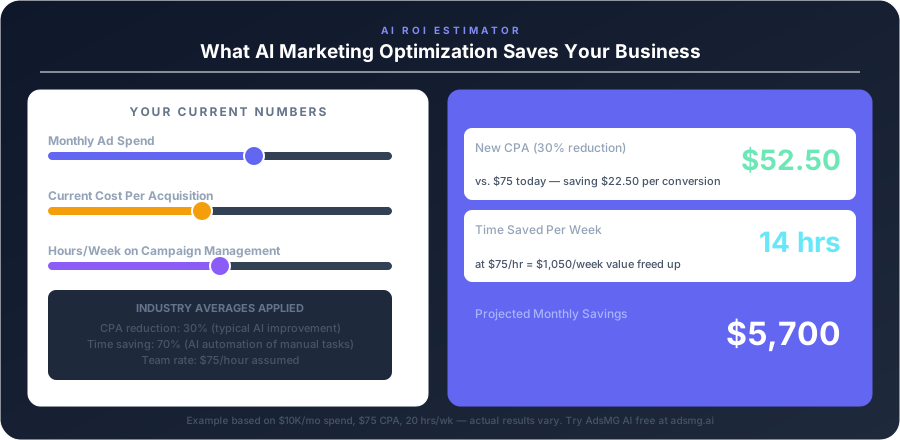
Example calculation for a $10,000/month ad budget:
- Manual management CPA: $75 (industry average)
- AI-optimized CPA: $52.50 (35% improvement)
- Monthly conversions with manual: 133
- Monthly conversions with AI: 190
- Additional monthly revenue at $200 AOV: $11,400
- AI tool cost: ~$200/month
- Net monthly gain from AI: ~$11,200
Even conservative AI performance improvements represent significant financial opportunity for businesses spending $3,000+/month on advertising. The longer the delay, the more value is left on the table.
Ad Spend Reduction Benchmarks by Industry
Before setting expectations, calibrate against industry-specific performance data. AI optimization impact varies significantly by vertical:
| Industry | Avg. CPA Before AI | Avg. CPA After AI | Typical Reduction |
|---|---|---|---|
| E-commerce (fashion) | $42 | $27 | 36% |
| E-commerce (home goods) | $38 | $25 | 34% |
| SaaS / software | $180 | $112 | 38% |
| Local services | $65 | $44 | 32% |
| Real estate | $95 | $61 | 36% |
| Education / online courses | $55 | $36 | 35% |
| Financial services | $210 | $147 | 30% |
Source: Aggregate data from AI-managed campaigns across platforms, 2025–2026.
Key insight: Industries with high purchase intent signals (real estate, education) see above-average AI lift because intent data improves AI bidding accuracy dramatically. Industries with long consideration cycles (financial services) see slightly lower but still significant CPA reductions.
Related Resources
- AI Advertising Statistics 2026 — Benchmarks for cost reduction
- Google Ads AI Optimization 2026 — Platform-level AI strategies
- AI Marketing ROI Guide — Measuring performance improvements
- AI ROI Calculator — Calculate your potential savings before you start
AdsMG AI Team — AI marketing specialists with hands-on experience managing $10M+ in annual ad spend across Google, Meta, LinkedIn, and programmatic channels. AdsMG AI has helped 500+ businesses reduce cost-per-acquisition by an average of 32% through AI-powered advertising automation. Every article is written or reviewed by practitioners who run real campaigns with real budgets. Learn more about AdsMG AI →
Frequently Asked Questions
Use these answers as the quick-reference layer for common objections, buying questions, and implementation concerns.
How much can AI reduce my advertising costs?+
AI advertising optimization typically reduces costperacquisition (CPA) by 2545% compared to manually managed campaigns. Google reports that advertisers using AI bidding see 20%+ improvement in conversion value at the same cost. Specific results vary by industry, ad platform, and starting baseline, but meaningful cost reduction is achievable within 48 weeks of implementing AI optimization.
What is the fastest way to reduce ad spend with AI?+
The fastest wins from AI: (1) Switch to automated bidding (Target CPA or Target ROAS) immediately — this alone delivers 20%+ efficiency in most cases, (2) Use AI to eliminate wasted spend on poorly performing keywords, audiences, and placements, (3) Use AI creative testing to find highperforming ad variants faster. These three moves can show results within 24 weeks.
Does using AI for advertising mean I need less budget?+
AI optimization makes existing budget more efficient rather than necessarily requiring less total budget. The efficiency gains from AI (lower CPA, higher ROAS) mean you get more results from the same spend — or achieve the same results with less spend. Many businesses reinvest efficiency gains into expanded reach rather than reducing total budget.
Can AI help me stop wasting money on bad ads?+
Yes. AI identifies underperforming creative, audiences, placements, and keywords faster than manual review — automatically shifting budget away from waste and toward proven performers. AI systems monitor performance 24/7, making optimizations in real time that a manual manager would only catch in weekly reviews.
What AI tools are best for reducing ad costs?+
The best AI tools for reducing ad costs are: AdsMG AI (crosschannel AI optimization), Google's Smart Bidding (automatic bid optimization on Google), Meta's Advantage+ Shopping (AIpowered ecommerce campaigns), and Google's Performance Max (AI campaign across all Google inventory). Each reduces wasted spend through automated optimization.
How do I know if AI is actually saving me money on ads?+
Track these metrics before and after implementing AI: Costperacquisition (CPA), Return on ad spend (ROAS), Costperclick (CPC), Clickthrough rate (CTR), and Conversion rate. Compare 30day periods before and after AI implementation. Account for external factors like seasonality. Most businesses see measurable CPA improvement within 3060 days.
Turn the ideas in this article into live campaigns, content, and creative tests.
AdsMG AI helps growth teams move from strategy to execution without stitching together separate tools for copy, optimization, and reporting.